
Ask any homeowner why they picked a particular window, and most will say it slid open smoothly the day it was installed. That’s not a real test, though nearly every window feels good on day one. The window that’s worth paying for is the one that still opens with a light touch, still seals out the cold, and still looks sharp several summers and winters later. If you’re weighing sliding windows for a renovation or a room-by-room upgrade, the real work is figuring out which options are built to hold that performance, not just demonstrate it once in a showroom.
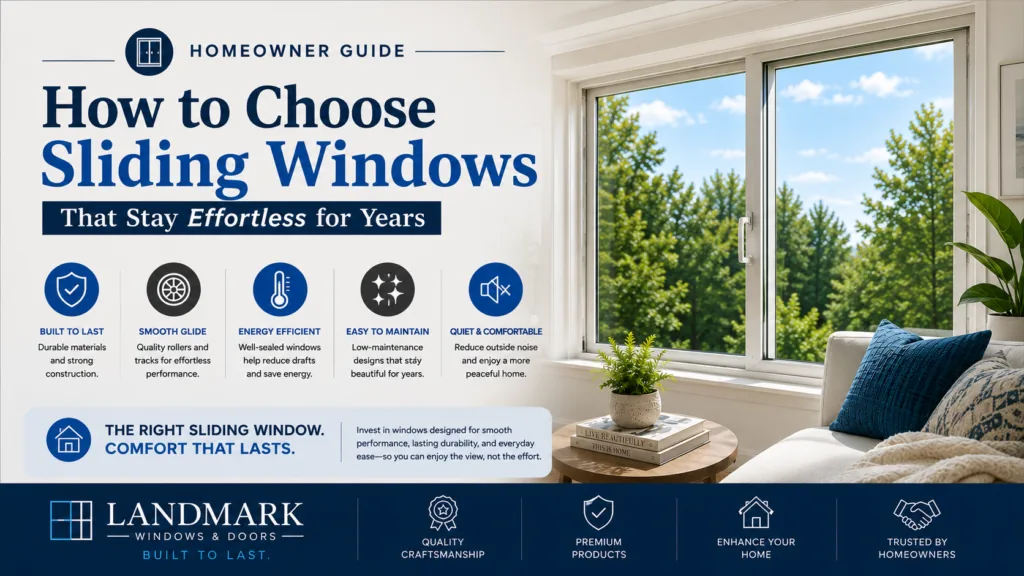
Start With What’s Actually Bothering You Now
If you’re shopping for new windows, chances are something specific prompted it a track that’s gotten stiff, a draft you can feel near the frame, or a general sense that the window just isn’t performing the way it used to. Naming that problem clearly is the first step toward avoiding it a second time.
Think through:
What’s failing right now – a stuck sash, a whistling draft, visible wear on the frame?
How much daily use the window gets – a kitchen window opened constantly versus a hallway window rarely touched?
Sun and weather exposure – south-facing and storm-exposed windows face more stress than shaded, sheltered ones.
Your appetite for upkeep – do you want to lubricate a track occasionally, or would you rather never think about it?
Whether this is one window or several – a single replacement versus a broader home upgrade changes the calculus.
Once you can name the actual problem you’re solving, it’s much easier to filter out windows that look fine but won’t hold up the same way yours did.
The Engineering Details That Decide Whether a Window Stays Effortless
A showroom demo can’t tell you how a window will feel in year six. What can tell you is the hardware and materials underneath the surface.
Roller Hardware. Brass rollers in a tandem configuration are designed to absorb the repeated stress of daily sliding without the seizing or grinding that plastic rollers tend to develop after a season or two of regular use.
Frame Composition. A specially formulated PVC that resists scratching and denting, built with a welded rather than mechanically fastened sash and frame, holds its shape through temperature swings far better than standard-grade vinyl.
Seal Technology. A magnetic seal combined with triple-layer weatherstripping stays airtight even as the frame naturally shifts with the seasons, which is typically where budget windows begin to fail first.
Wind and Structural Resistance. An interlocking sill and sash design, reinforced with Q-Lon bulb-seal compression, keeps the window performing under heavy wind loads instead of loosening its seal over time.
Thermal Core. VyFoam™ insulation inside the frame and sash, paired with high-performance Low-E glass, is built to maintain its insulating value for the long haul rather than compressing or degrading the way older insulation materials often do.
Once you know which of these details map to the problem you identified earlier, you can compare products on substance instead of a smooth first impression.
Questions Worth Asking Before You Sign Anything
A few pointed questions can tell you more about long-term performance than any brochure:
- What material are your rollers made from, and how do they typically hold up after several years of use?
- Do you offer sliding window replacement one unit at a time, or only as part of a larger project?
- Walk me through your sliding window installation process. What steps ensure a proper seal around the frame?
- How does your weatherstripping perform after repeated hot-and-cold seasonal cycles?
- Is the warranty the same across rollers, seals, and frame, or does coverage differ by component?
- Do you have installations from several years back you can point to that are still performing well?
The value in these questions isn’t the answers alone, it’s how specifically a provider answers them. Vague responses usually mean vague accountability down the line.
Why Installation Quality Matters as Much as the Window Itself
Even a well-built window can underperform if the installation is rushed. A track that isn’t level, gaps left around the frame, or a poorly sealed edge can undercut the hardware’s performance within the first year, regardless of how good it is on paper. A provider who explains their process clearly, sets a realistic timeline, and gives you one point of contact for questions after the job is done is usually one who treats installation as seriously as the product itself.
Weighing Cost Against What You’re Actually Paying For
The lowest quote on the table often comes from the thinnest hardware and the least durable seals savings today that tend to show up as repair costs or premature replacement a few years down the line.
A transparent quote should separate out material costs, labor, and warranty terms so you can see exactly what’s driving the price. Rather than comparing the bottom-line number alone, it’s worth asking what each option is likely to cost you over its full lifespan, not just on installation day.
A Practical Checklist for Choosing Windows That Last
- Roller durability – Brass or comparably rated rollers, not standard plastic.
- Frame resilience – PVC construction that resists scratching, denting, and warping.
- Seal integrity – Magnetic seals with multi-layer weatherstripping.
- Wind performance – Interlocking sill/sash design rated for heavy wind loads.
- Insulation quality – A thermal core designed to hold its value over time.
- Installer history – A provider with verifiable, long-standing installs you can reference.
- Warranty transparency – Clear coverage terms for hardware, seals, and frame separately.
Conclusion
The window that impresses you in a showroom isn’t necessarily the one that will still impress you five years from now. Roller hardware, frame material, and sealing technology are what actually determine whether a window stays effortless or starts showing its age within a season or two and asking the right questions upfront is how you tell the two apart before committing. Whether the plan is a targeted sliding window replacement for one problem area or a broader upgrade across the home, the difference between a window that lasts and one that doesn’t usually comes down to who installs it and what’s backing the warranty. Landmark Windows & Doors has built its Fredericksburg reputation on windows and installations designed to hold up long after the first impression fades.